
There’s been an incredible amount of innovation in financial advice AI over the last three years. First, dedicated notetakers like Saturn arrived. Then suitability report generators, AI-powered CRM solutions, and more.
I’ve seen solutions like these halve an adviser’s admin burden (sometimes more). But the “fix” isn’t found in the “right” tool. The key is taking a flexible, yet strategic approach – one that lets you adapt to new tech as it arrives (which is happening constantly), and swap out components as you need.
AI won’t replace you. But it can give you back 5-10 hours a week, or even more. That’s genuinely transformative when you’re managing a growing client bank in 2026.
The Post-Meeting Admin Trap
Most UK advisers spend 40-60% of their working week on administrative tasks rather than client-facing activities. Post-meeting admin is the worst offender.
You finish a client review. Then you spend 45 minutes typing up notes, checking your memory against scribbled remarks, updating the CRM, drafting follow-up emails and populating suitability templates.
Multiply that across 15-20 client meetings a week and you’ve lost at least two full working days to data entry.
The real cost isn’t just time. It’s the mental drain of switching between strategic advice work and administrative drudgery. That context-switching kills momentum and makes every day feel exhausting.
Key Takeaways
-
A compliant AI transcription tool can capture 80% of meeting content accurately, reducing post-meeting admin by 5-10 hours weekly
-
Real-world UK meetings with regional accents produce 12-25% error rates, so human review remains essential for compliance
-
Modular tech stacks using middleware (n8n or Make) offer flexibility to swap components as AI technology matures
-
Strategic automation focuses on volume work while preserving human judgement for suitability language and compliance
Enhancing Operational Efficiency and Client Engagement with AI
AI transcription tools can handle the bulk of meeting documentation automatically, allowing you to focus on refining advice quality and strengthening client relationships rather than drowning in post-meeting admin tasks.
AI Won’t Replace You. But It Can Give You Back 5-10 Hours a Week
A compliant AI transcription tool can capture up to 80% of your client meeting accurately. That’s genuinely useful for speeding up note capture and minimising missed details.
But if you’re in Glasgow or Newcastle, expect closer to 75%. Regional accents still trip up most AI transcribers.
The real win isn’t replacing human judgement. It’s using AI to handle the volume work so you can focus on the nuance: refining suitability language, spotting compliance gaps and actually engaging with clients instead of drowning in post-meeting admin.
That’s the transformation worth pursuing.
The Critical Role of Compliant AI Notetakers and Their Limitations
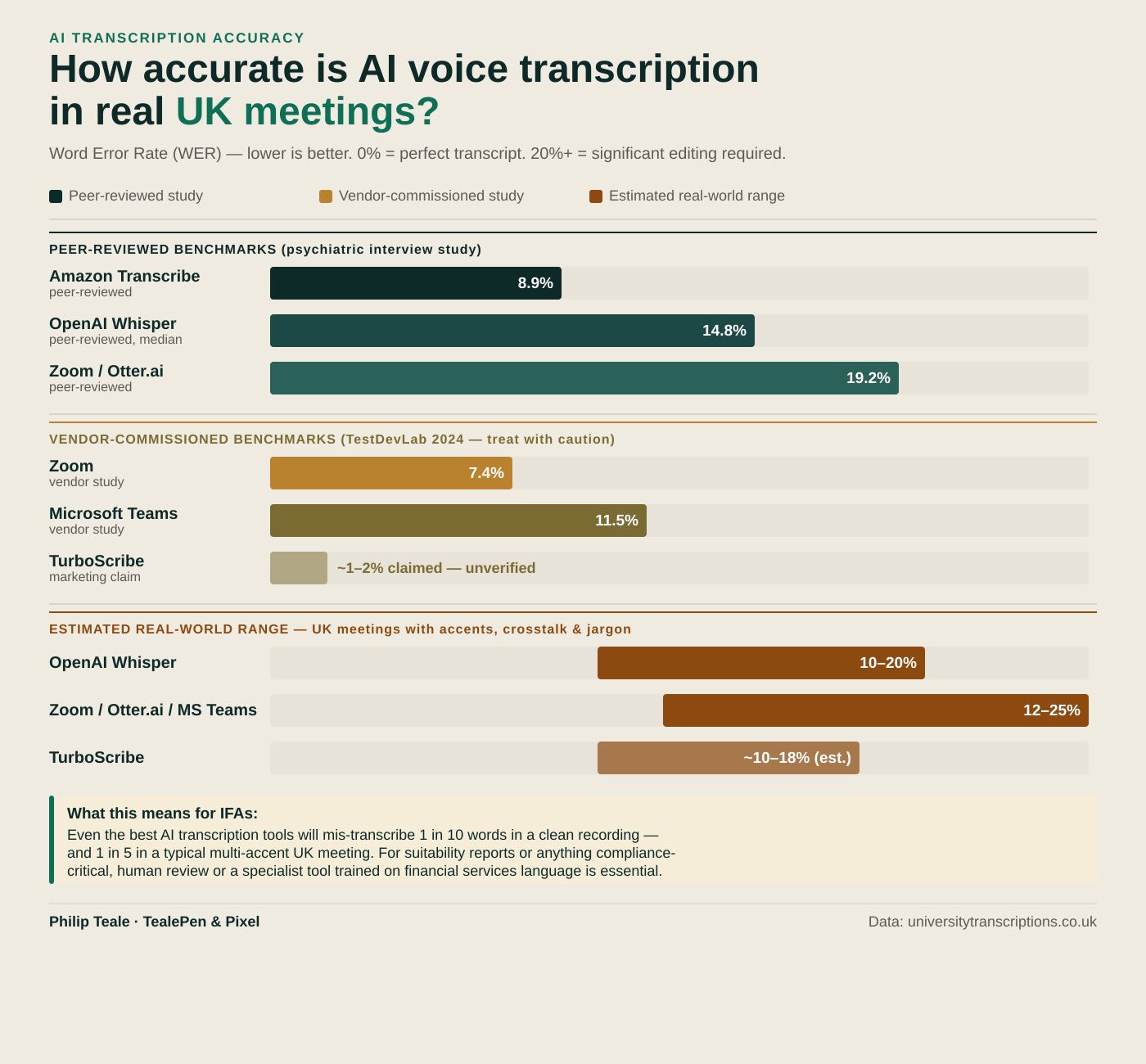
Even the best AI transcription tools produce word error rates between 8.9-14.8% under controlled conditions, with real-world UK meetings generating significantly higher error rates that require careful human oversight before any compliance documentation.
Understanding AI Transcription Accuracy: Risks and Rewards for UK Advisers
I recently reviewed a study on AI transcription accuracy published by University Transcriptions that should give pause to every UK adviser using these tools for client meetings.
Even under controlled conditions, the best tools still produced 8.9-14.8% word error rates. In real-world UK meetings with regional accents, crosstalk and poor audio? Expect 12-25% error rates.
That’s one in five words potentially wrong.
For a podcast, that’s manageable. For a suitability report, that’s a compliance risk.
Here’s what I tell advisers: use compliant AI notetakers to accelerate note capture and catch details you might miss. They’re brilliant for that initial 80% of the work.
But you cannot outsource the final review to the machine.
The Financial Conduct Authority’s Consumer Duty rules demand that you demonstrate good outcomes. An AI-generated transcript riddled with errors won’t protect you if a client disputes your advice in 2026.
The strategic question isn’t which tool to buy. It’s how you build a modular tech stack that lets you adapt as this technology improves without locking yourself into one vendor’s limitations.
Leveraging AI for Seamless CRM Updates and Automated Reporting
Strategic automation pushes meeting notes directly into your CRM and auto-populates client records, but only when you build modular systems that clean and structure data properly before it enters Intelliflo or Xplan.
Automating Data Entry and Report Generation with AI: Tools and Best Practices
AI can push meeting notes straight into your CRM and auto-populate client records. In theory, it saves hours per week. In practice, it only works if you build it properly.
The best approach isn’t picking a single ‘all-in-one’ AI tool. It’s taking a modular view of your tech stack.
Use a compliant AI notetaker to capture the conversation and minimise missed details. But don’t rely on it blindly, especially if you’ve got regional accents in the room or crosstalk between advisers and clients. Real-world UK meetings can produce error rates of 12-25%.
Then route that output through middleware (like n8n or Make) to clean, structure and push data into Intelliflo or Xplan.
This gives you control. You’re not locked into one vendor’s roadmap, and you can swap components as the tech matures.
The goal isn’t full automation. It’s strategic automation that frees up your team without introducing compliance risk.
Strategic AI Integration: Building a Flexible Tech Stack for the Future
The firms thriving in 2026 build modular systems using best-in-class tools connected via API, allowing them to adapt quickly as AI technology evolves without rebuilding entire workflows around proprietary platform limitations.
Architecting a Resilient AI Strategy for Evolving UK Financial Advice Firms
The firms that will thrive through 2026 and beyond aren’t the ones betting everything on a single AI platform. They’re building modular systems that adapt as the technology matures.
I’ve watched too many advisers lock themselves into proprietary solutions that promise to “do everything”, only to find themselves trapped when a better tool emerges six months later.
Your AI strategy should be flexible by design. Use best-in-class tools that integrate via API, not monolithic platforms that demand you rebuild your entire workflow around their limitations.
Take meeting notes as an example. A compliant transcription tool can accelerate your note capture and catch details you’d otherwise miss. But it can’t replace your judgement about what matters for suitability.
The smartest approach?
Layer AI capabilities onto your existing CRM and back-office systems. Let the machines handle volume and speed. You handle strategy, compliance and the 20% that actually builds client trust.
Invitation
Mastering AI for meeting notes and CRM is a powerful step, yet it’s just one piece of the puzzle for a thriving advisory practice.
To understand your current growth capabilities and identify areas for further optimization, take a few minutes to complete our free Advisor Growth Score.
Frequently Asked Questions
Can AI transcription tools fully replace manual note-taking for compliance purposes?
No. Even the best AI transcription tools produce error rates of 12-25% in real-world UK meetings with regional accents and crosstalk. You should use them to accelerate the initial 80% of note capture, but always conduct a thorough human review before incorporating any content into suitability reports or compliance documentation. The FCA’s Consumer Duty requires you to demonstrate good client outcomes, and AI-generated transcripts alone won’t protect you if advice is disputed.
Which CRM systems integrate best with AI meeting note tools?
Modern UK adviser CRMs like Intelliflo and Xplan can sometimes support API integrations, but you’ll typically need middleware (n8n or Make) to clean and structure AI-generated data before pushing it into your CRM. The key is building a modular tech stack rather than relying on a single all-in-one platform. This gives you the flexibility to swap components as AI technology improves without rebuilding your entire workflow.
How much time can UK advisers realistically save using AI for post-meeting admin?
Firms implementing compliant AI transcription tools combined with automated CRM workflows typically reclaim 5-10 hours per adviser each week. However, this depends on proper implementation. You need to build structured processes for reviewing AI outputs, correcting errors and routing clean data into your back-office systems. The goal isn’t eliminating human involvement but reducing low-value data entry so you can focus on advice quality and client relationships.
What are the main compliance risks of using AI for meeting notes?
The primary risk is treating AI-generated transcripts as accurate without human verification. Transcription errors could misrepresent client instructions, risk tolerances or agreed actions, creating significant regulatory exposure. You must also ensure your AI tools are GDPR-compliant for handling client data and that you retain full audit trails showing how meeting notes were captured, reviewed and approved. Never allow AI outputs to enter suitability reports or client communications without thorough review by a qualified adviser or paraplanner.

Philip Teale is a MCIM marketer with over 10 years’ experience working with financial advisors – helping them gain new revenue and clients using online channels and AI-powered workflows.