
Ian Else, financial adviser, just gained a client in an unusual way. His new client had uploaded their portfolio statement to ChatGPT. 1.21% all-in. 30+ funds. Less than £500,000 in assets. ChatGPT’s verdict? The portfolio “lacked any real conviction” and they’d be better served by a fixed-fee planner with cash flow modelling. So the client found one. And moved.
Ian made a point that stuck with me: it’s naive to think AI isn’t going to educate people about what’s reasonable and what represents fair value.
Your clients now have access to an analyst in their pocket. One that doesn’t soften feedback. One that won’t spare feelings to protect a relationship.
Some of them are already using it to scrutinise what they’re paying you.
And it all gets very close to the uncomfortable question: “Will AI replace financial advisers?”
The Problem
Financial adviser clients can now query sophisticated AI models about their portfolios, fees and the value they’re receiving from their adviser. These tools don’t have commercial relationships to protect or renewal fees to worry about. They provide free, conversational assessments that are shaking up the traditional adviser-client dynamic.
For advisers charging average fees whilst delivering below-average value, this democratisation of financial analysis goes beyond just feeling uncomfortable. It could be existential.
Most are (rightly) accepting that AI will impact their practices. The real question now is: will you be on the right side of that impact?
Key Takeaways
- Clients are already using AI tools like ChatGPT to evaluate their advisers’ performance, fees and value proposition
- AI excels at data processing and analysis but fundamentally lacks real empathy, theory of mind and the ability to navigate complex human emotions
- Advisers charging high fees for low-touch service are most at risk of AI-driven client attrition
- The winning strategy is “AI-powered, human-first”: using technology to automate commoditised work whilst focusing on irreplaceable human skills
- Building practices where AI would recommend you, not question you, is the key to thriving beyond 2026
The Disruptive Force of AI in UK Financial Advice
AI is fundamentally reshaping how clients evaluate financial advice by providing instant, free analysis of portfolios, fees and adviser performance. According to the Financial Conduct Authority’s review of AI in financial services, consumers are increasingly using AI tools to make more informed decisions about their finances, creating new expectations for transparency and value.
This shift isn’t gradual. It’s happening right now, and it’s changing the power dynamic between advisers and clients in ways that weren’t possible even two years ago.
When Clients Consult ChatGPT: A Wake-Up Call for Advisers
Ian Else’s story isn’t an outlier anymore. I’m hearing more and more variations of it across the advice profession. Clients uploading statements, querying fee structures, asking AI whether their drawdown strategy makes sense given current interest rates.
What makes this particularly challenging is the quality of the feedback AI provides. Yes, it can give spectacularly bad advice. But it isn’t guessing, and it isn’t useless.
It’s analysing against best practices, comparing to industry benchmarks and identifying inconsistencies that clients might never have questioned before.
The advisers who think this is rare or isolated are the ones most at risk. Your clients have access to analytical capability that would’ve cost tens of thousands in consulting fees five years ago.
Now it’s free, instant and it’s getting increasingly more accurate.
Unpacking AI’s Strengths and Weaknesses for Financial Guidance
I’ve spent considerable time testing AI models against real advisory scenarios. The results are clear: AI is extraordinarily good at certain tasks and spectacularly bad at others.
AI can process a portfolio in seconds, identify concentration risk, flag tax inefficiencies and benchmark fees against industry averages. It can run Monte Carlo simulations, generate cashflow projections and identify optimal withdrawal strategies.
What it can’t do is understand why a 68-year-old client is reluctant to spend despite having £2 million in assets. It doesn’t grasp the emotional weight of a decision made under grief. It struggles to read body language or sense when silence means disagreement rather than contemplation.
AI-driven tools can excel at optimising portfolios based on quantitative factors. But they consistently fail at incorporating the behavioural and emotional elements that drive real-world financial decisions.
Beyond Algorithms: What AI Can’t Yet Grasp
I’ve built (and watched) many AI workflows. They’re like a hugely talented, vastly-overconfident intern. They can handle complex tax scenarios brilliantly whilst completely missing the human element.
A client couple disagreeing about retirement timing because one feels undervalued in the relationship? AI sees it as a data input problem.
A widow hesitating to invest her late husband’s life insurance payout? To AI, it’s about risk tolerance and time horizon. It doesn’t understand that moving that money feels like losing him all over again.
This isn’t a temporary limitation waiting for GPT-6 to fix. It’s architectural. AI lacks theory of mind. It doesn’t experience regret, anticipate legacy concerns or navigate the messy reality of financial decisions made under emotional duress.
That’s your edge. Not your CII qualification or your investment process. Your ability to hold space for difficult conversations whilst protecting someone’s financial future.
The Irreplaceable Human Edge: Why Empathy and Trust Still Reign
The advisers who’ll thrive in 2026 and beyond aren’t just building sophisticated tech stacks. They’re building practices where their human judgement, empathy and ability to navigate life transitions are impossible to replicate by AI.
Your value isn’t in the portfolio you build. It’s in guiding a client through divorce whilst protecting their pension. Helping someone navigate redundancy at 58 without derailing retirement. Mediating family tensions around inheritance before they fracture relationships.
AI can’t do that work. It can’t even approximate it.
The Advisers at Risk and Those Who Will Prosper
I’ve watched this divide widen dramatically over the past year. The advisers at risk are easy to identify. They’re charging 1% across the board with little to show beyond an annual meeting and a portfolio review built around graphs.
Their clients are already uploading statements to ChatGPT and asking if they’re getting value. Some are leaving. More will follow.
The advisers who’ll prosper are those who can confidently say: “Ask ChatGPT about me. I’d love to hear what it says.”
That confidence comes from delivering genuine financial planning, not asset-gathering dressed up as advice. It comes from building relationships where your human judgement, empathy and ability to navigate life transitions are impossible to replicate.
AI can analyse a portfolio. It can’t hold a client’s hand through divorce, redundancy or bereavement whilst protecting their financial future.
If your practice relies primarily on investment management and annual reviews, you’re competing with AI. If your practice is built on financial planning, life transition guidance and proactive relationship management, AI is making you more valuable, not less.
The difference is whether AI sees you as competition or confirmation that the client needs human expertise.
Thriving in the AI Era: Adopting an “AI-Powered, Human-First” Strategy
The winning strategy for 2026 doesn’t choose between technology and relationships. It uses AI to eliminate commoditised work so you can focus entirely on what machines can’t replicate: empathy, complex judgement and genuine financial planning that navigates the messy reality of human life.
This means systematically identifying every task in your practice that doesn’t require human judgement. Then, you find a way to automate it. Meeting notes, client onboarding workflows, compliance documentation, portfolio rebalancing alerts. All of it.
Then doubling down on what AI can’t touch: face-to-face conversations, proactive planning, life transition guidance and demonstrable value that clients can feel, not just see on a statement.
Building a Future-Proof Practice with AI Integration
AI won’t replace you, but advisers who use AI well will replace those who don’t. The practical application looks like this:
- AI handles meeting transcription and action item extraction. You focus on the conversation.
- AI generates initial cashflow scenarios based on client data. You interpret them through the lens of what you know about their risk tolerance, family dynamics and unspoken concerns.
- AI flags portfolio drift and tax-loss harvesting opportunities. You decide which ones matter given what’s happening in the client’s life right now.
This means automating meeting notes, client onboarding workflows and compliance documentation whilst doubling down on face-to-face conversations, proactive planning and demonstrable value.
The advisers I work with are building practices where ChatGPT would recommend them, not question them. They’re using AI to become more human, not less. They’re spending less time on administrative work and more time on the conversations that actually matter.
That’s the strategy that survives 2026 and beyond. Not resisting AI. Not being replaced by it. Using it to do more of what only humans can do whilst machines handle everything else.
Invitation
Understanding how AI will shape your practice is crucial for future success.
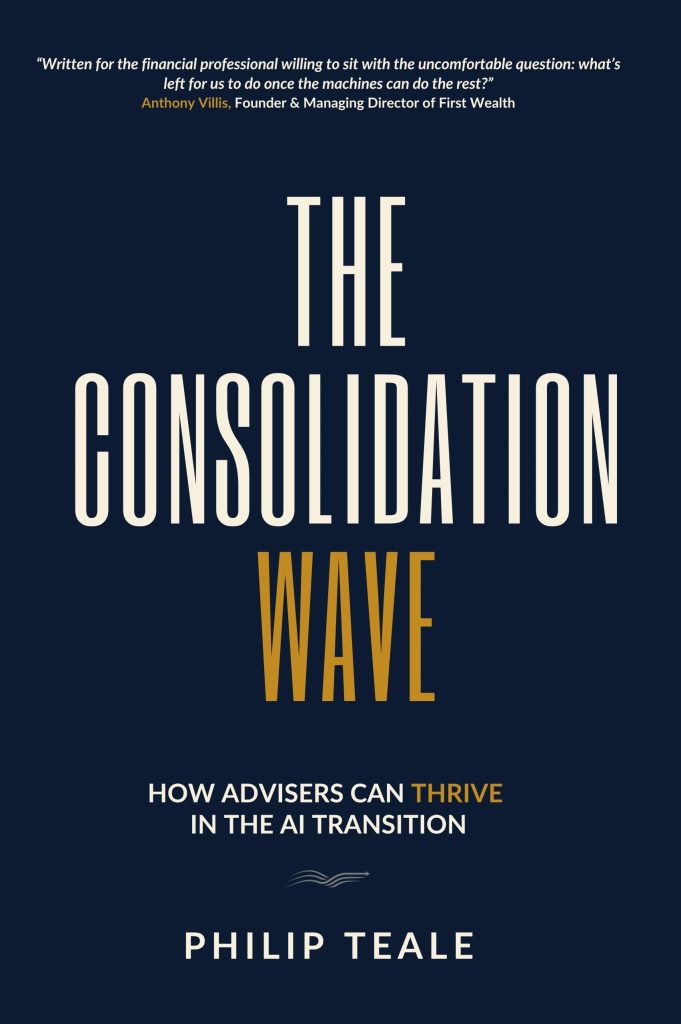
To truly thrive in this evolving landscape and ensure you’re leveraging technology effectively, you can read my book on this very topic (available on Amazon):
Frequently Asked Questions
Will AI completely replace financial advisers in the next five years?
No. AI will place huge pressure on advisers who provide commoditised services like basic portfolio management and annual reviews. Advisers who deliver genuine financial planning, navigate complex life transitions and provide empathetic guidance through major financial decisions will become more valuable. The key is using AI to handle data processing and administrative tasks whilst focusing on irreplaceable human skills.
How are clients currently using AI to evaluate their financial advisers?
Clients are uploading portfolio statements to tools like ChatGPT and asking whether their fees represent fair value, whether their portfolio construction makes sense and whether they should consider alternative advice models. AI provides unbiased analysis against industry benchmarks, often highlighting issues clients never questioned before. This is creating a new level of fee transparency and accountability.
What specific tasks should financial advisers automate with AI in 2026?
Focus on automating meeting transcription and note-taking, client onboarding workflows, compliance documentation, portfolio rebalancing alerts and initial cashflow scenario generation. These are tasks that don’t require human judgement but consume significant time. Automating them frees you to focus on client conversations, proactive planning and the relationship work that AI can’t replicate.
How can I tell if my practice is at risk from AI disruption?
Ask yourself: would ChatGPT recommend me to my clients, or question the value I provide? If your service model relies primarily on portfolio management and annual reviews with fees around 1%, you’re at risk. If you’re delivering comprehensive financial planning, navigating life transitions and providing proactive guidance where your empathy and judgement are clearly valuable, AI makes you more valuable, not less. The test is whether clients could replicate most of your value through free AI tools.

Philip Teale is a MCIM marketer with over 10 years’ experience working with financial advisors – helping them gain new revenue and clients using online channels and AI-powered workflows.