I’ve spoken to many financial advisers who are interested in Facebook Ads. Often, the subject comes up out of frustration. Other lead generation channels don’t seem to be working, and Meta (Facebook) seems like a silver bullet.
So they launch a campaign, drive traffic to a basic landing page and wonder why qualified leads don’t pour in.
The reality is harsher: without a proper nurture system, Facebook ads become an expensive awareness exercise that burns budget without building pipeline.
You’re competing for attention in a feed full of distractions, and if your post-click experience doesn’t immediately build trust, you’ve already lost.
Key Takeaways
- Facebook ads do work in 2026, but they need to be paired with a content ecosystem that builds trust across multiple touchpoints.
- Precision targeting allows you to reach ideal clients based on demographics, location and life events without wasting budget on unqualified audiences
- Compliance shouldn’t be seen as a constraint but a quality filter. Focus on solving real client problems rather than making unsubstantiated claims
- Measuring ROI requires tracking beyond platform metrics to understand true lead quality and content consumption before conversion
The Strategic Advantage of Facebook Ads for Financial Advisors
When used correctly, Facebook Ads work for financial advisers because they solve a targeting problem that no other channel can. You can reach families earning £75k+ within 10 miles of your office who’ve recently moved house. That’s not broad marketing. That’s surgical.
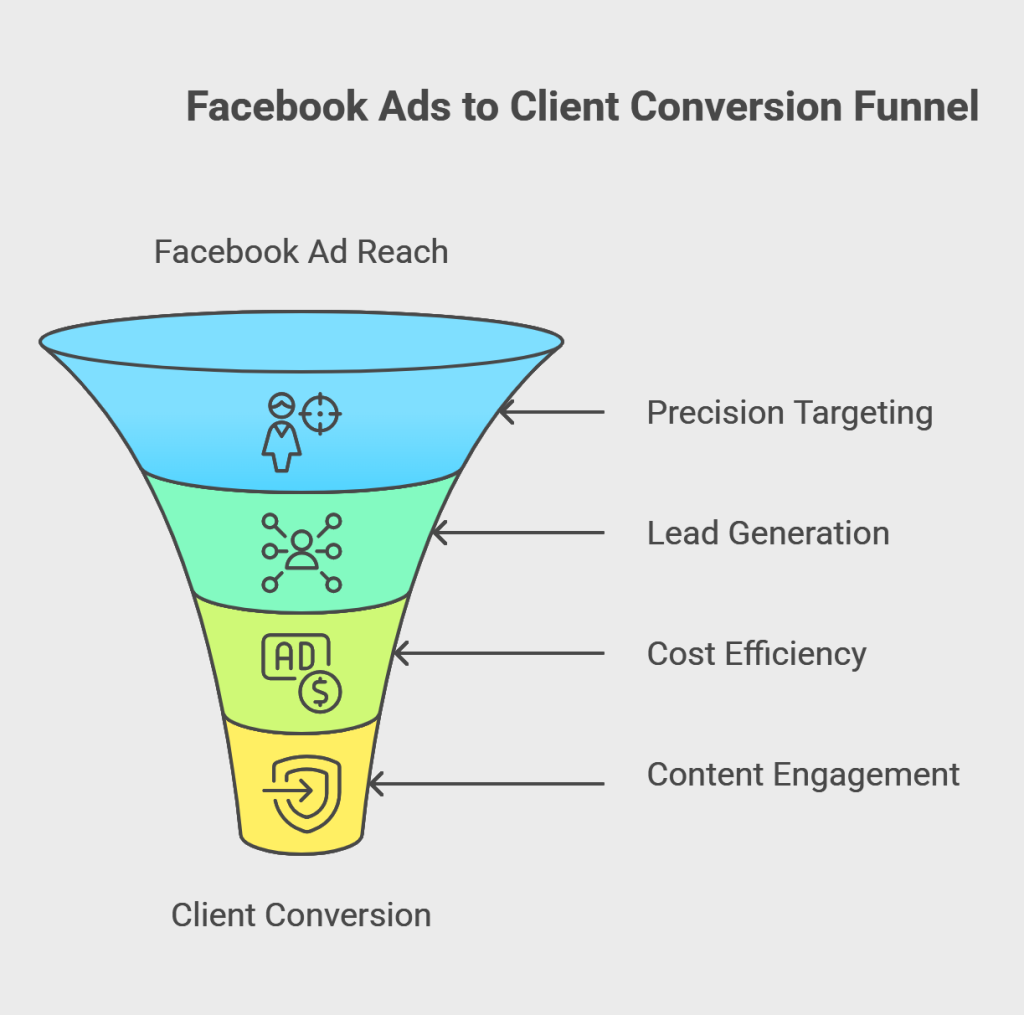
Key Benefits: Precision Targeting, Lead Generation and Cost Efficiency
The key advantages are clear, but they only matter if you’ve got the infrastructure to capitalise on them.
Precision targeting gives you control that traditional methods never could. Demographics, location, life events and behaviours let you find your ideal client without wasting budget on the wrong audience.
You’re not hoping the right person walks into a seminar. You’re putting your message directly in front of them.
Lead generation at scale becomes possible when you build it right. A well-constructed campaign can deliver 20-40 qualified enquiries per month for £1,500-£3,000 in ad spend. That’s data I’ve seen replicated across multiple adviser clients over the past three years.
Cost efficiency compared to traditional methods is significant. Seminars, direct mail and networking events all have their place, but Facebook delivers measurable cost-per-lead data you can actually optimise. You know exactly what you’re paying for each enquiry.
But here’s what most advisers miss: the ad is just the entry point. Without a content system behind it that builds trust across multiple touchpoints, you’re burning money on clicks that go nowhere.
This is where the 7-11-4 Rule comes into play. Your prospects need roughly seven hours of engagement, across eleven touchpoints, on four different platforms before they trust you enough to book a meeting.
Facebook ads accelerate that process by delivering the first touchpoint with precision. But if you don’t have content ready for touchpoints two through eleven, you’re leaving pipeline on the table.
A Practical Guide to Setting Up Your Facebook Ad Campaigns
Setting up Facebook ad campaigns correctly from day one saves you from expensive mistakes later. The technical foundation matters just as much as your creative, and most advisers rush through this part without realising they’re building on sand.
Establishing Meta Business Manager and Defining Your Target Audience
Start by creating a Meta Business Manager account at business.facebook.com. This separates your firm’s advertising from personal profiles and gives you proper oversight.
Once you’re in, you’ll need to add your Facebook Page, create an Ad Account and install the Meta Pixel on your website. Your developer can handle the pixel installation in 20 minutes. If they can’t, you need a different developer.
The targeting is where most advisers overthink it. In 2026, Meta’s algorithm is good enough that you don’t need to micro-segment like we did five years ago.
I typically start with:
- Location: 15-mile radius around your office
- Age: 45-65
- Interests: Retirement planning, investing, pensions
- Exclude: Current clients (upload a customer list)
You can layer in income proxies like job titles or postcode data, but honestly, your offer and creative will do more filtering than any audience setting ever will.
The real precision comes from your messaging, not your targeting parameters. If your ad speaks directly to someone worried about inheritance tax planning, it’ll naturally filter out people who aren’t in that situation.
That’s more powerful than trying to find an “inheritance tax aware” interest group that doesn’t exist.
Designing High-Impact and Compliant Facebook Ad Content
Your creative needs to do two jobs simultaneously: stop the scroll and stay compliant. That’s harder than it sounds, but it’s entirely possible when you focus on problems instead of promises.
Start with your visual. Clean, professional imagery works better than stock photos of handshakes or sunsets.
You can get strong results with simple text-on-colour graphics that pose a question. “How much inheritance tax will your family pay?” over a dark blue background outperforms generic lifestyle imagery every time.
Your copy should speak to a specific pain point without making unsubstantiated claims. “Worried about inheritance tax planning?” works. “We’ll save you 40% on IHT” doesn’t. The FCA won’t let you make the second claim, and even if they did, it sounds like an empty promise.
The path from digital advertising to qualified leads requires messaging consistency at every stage. If your ad promises “clarity on pension options” but your landing page is a generic “about us” page, you’ve broken the chain.
Ensuring Regulatory Compliance in Your Facebook Advertising Efforts
Compliance isn’t a constraint. It’s a filter for quality. Every failed adviser ad I’ve reviewed over the past decade failed because it tried to shortcut trust with hyperbole.
Your Facebook ad content needs to pass two tests simultaneously. First, the FCA’s financial promotion rules. Second, the “would I actually click this?” test. Most advisers optimise for one and ignore the other.
Avoid specific return figures, past performance claims or anything that implies guaranteed outcomes. Instead, focus on the problem you solve. “Worried your pension won’t last?” is compliant and compelling. “Our clients retire with 30% more income” is neither.
Every ad needs a clear disclaimer and risk warning where appropriate. I build these into the creative from day one, not as an afterthought. It’s easier to design around a disclaimer than to shoehorn one in later.
The landing page matters just as much. If your ad is compliant but your landing page isn’t, you’re still liable. Keep your messaging consistent across the entire journey. The same language, the same tone, the same level of caution.
For more detail on staying compliant while still creating effective marketing, I’ve covered the specifics of avoiding misleading claims in financial advertising in depth elsewhere.
Optimising Performance and Measuring ROI for Financial Advisor Ads
Measuring Facebook ad performance properly means looking beyond the platform’s self-reported metrics. Meta will happily take credit for conversions it barely influenced, and if you’re not tracking the full journey, you’ll optimise for the wrong outcomes.
Analysing Key Metrics and Integrating Facebook Ads with Broader Marketing Initiatives
Facebook data alone will lie to you. The platform will tell you someone clicked. It won’t tell you they also read three blog posts, opened two emails and downloaded your pension transfer guide before they finally enquired.
That’s why I integrate Facebook campaigns into a broader marketing ecosystem. Track cost per lead, yes. But also track:
- Time to enquiry (from first click to form fill)
- Lead quality score (do they match your ideal client profile?)
- Content consumption before conversion (which touchpoints actually built trust?)
In 2026, the advisers winning with Facebook ads aren’t running standalone campaigns. They’re using ads to accelerate an engine that’s already producing authority content, nurturing sequences and SEO visibility.
This is what I call a Lead Ecosystem rather than a traditional funnel. Funnels assume linear progression. Ecosystems recognise that prospects bounce around between touchpoints before they convert.
Your Facebook ad might be touchpoint one. Or it might be touchpoint seven. Either way, it needs to connect to everything else you’re doing.
If your ad sends someone to a landing page with no follow-up system, you’re not measuring ROI. You’re measuring waste.
The real question isn’t “how much did this lead cost?” It’s “how many of these leads turned into clients, and what was the full acquisition cost when you include all the touchpoints?”
Understanding your complete lead generation system is essential before you scale ad spend. Otherwise you’re just pouring budget into a leaky bucket.
Invitation
If you want to understand where your current marketing sits and identify the specific gaps in your lead generation system, take the Adviser Growth Score.
It’s a three-minute assessment that’ll show you exactly which areas need attention before you scale paid advertising.

And if you’re ready to build the automation infrastructure that turns Facebook leads into booked meetings without manual follow-up, <strong>request pricing and an outline for adviser-owned automations</strong>. I’ll show you exactly how the system works and what it costs to implement for your firm.
Frequently Asked Questions
How much should financial advisers budget for Facebook ads in 2026?
Start with £1,500-£2,000 per month minimum if you want meaningful data. Anything less and you won’t generate enough volume to optimise properly. Once you’ve validated your funnel and cost per qualified lead, you can scale up. I’ve seen adviser firms profitably spending £5,000-£8,000 monthly, but only after they’d built the content infrastructure to handle the lead volume.
What’s a realistic cost per lead for financial adviser Facebook ads?
Qualified leads typically cost between £40-£120 depending on your location, targeting and offer. London and the South East skew higher. Regional firms often see lower costs. But cost per lead is meaningless without knowing conversion rate. A £50 lead that converts at 20% is better than a £30 lead that converts at 5%. Focus on cost per client, not cost per lead.
Do Facebook ads work better than Google Ads for financial advisers?
They solve different problems. Google captures existing demand. Someone searching “financial adviser near me” already knows they want help. Facebook creates demand by putting your message in front of people who match your ideal client profile but aren’t actively searching yet. I run both for most clients because they complement each other. Facebook fills the top of the funnel. Google captures the bottom.
How long does it take to see results from Facebook ads for advisers?
Expect 4-6 weeks to gather enough data for meaningful optimisation. You might see leads in week one, but you won’t know if they’re quality leads until they’ve moved through your nurture sequence. Give it three months before you make any big strategic decisions. The advisers who quit after four weeks always quit right before the algorithm would have started working for them.

Philip Teale is a MCIM marketer with over 10 years’ experience working with financial advisors – helping them gain new revenue and clients using online channels and AI-powered workflows.