I spoke with an adviser in Worcester last week. He was overwhelmed by AI. He knew he needed to take the tech seriously, but didn’t know where to start.
Should he focus on learning to maximise ChatGPT? Or, was it better to focus on using advisertech solutions like Saturn OS? How many tools should he even use? (The last thing you want is 12+ AI subscriptions that you cannot fully manage or take advantage of).
On that MS Teams call, the core question kept surfacing: “Where do I actually begin?” It’s the question I hear most often from UK financial advisers. And the answer isn’t what you might expect.
The Short Answer
A small UK advice firm need to start with what AI can help them fix. This is the opposite to what advisertech providers will lead with (a tool recommendation). Don’t focus on what to buy. This is backwards. Instead, pick the single process in your firm that eats the most time relative to the value it creates. Then build your first AI workflow around that.
This will look different to each UK advice firm, but common candidates include:
- Suitability report generation
- Compliance reviews (e.g. of suitability report drafts!)
- Meeting note write ups
- Client onboarding paperwork
Take each problem in turn and design your AI workflow to solve it. Once it is compliant and your team is comfortable with it, you can publish it and move to the next one.
Sequence beats ambition every time.
Who This Is For
This article will be most relevant to a specific type of person at a UK advice firm:
- You’re a managing partner or director at a UK IFA firm with somewhere between two and twenty people
- You’ve been circling AI for months without landing anywhere
- You’re not anti-technology. You’ve used ChatGPT, Claude or Gemini. You can see the potential. But every time you sit down to actually implement something, you hit the same wall: too many options, no obvious sequence, and a nagging worry about what the FCA would say if something went wrong.
You’ve probably watched colleagues on LinkedIn posting about their AI workflows and felt a mixture of interest and inadequacy. Maybe you’ve attended a webinar or two. Perhaps you even bought a subscription to something, but you’ve barely touched it.
None of that makes you behind. It makes you a normal managing partner trying to run a firm whilst figuring out a technology shift that even the vendors can’t explain clearly.
The Real Problem Isn’t Knowledge. It’s Sequence.
For most advisers I meet, the issue isn’t always a lack of information. It’s that they’re overwhelmed by it. There’s a constant stream of new AI tools, new models and new adviser-specific solutions, and they have no idea where to start.
The result is choice paralysis. Advisers are not usually being deliberately slow or resistant to change. They just have little idea of what their “order of operations” should be.
There’s a parallel here with your own world (financial planning). When a potential client comes to you with a pension problem, you don’t hand them twelve options and say “Pick one”. You take time to understand where they are, where the biggest gaps exist, and where the client wants to be. From there, you can build a plan.
AI tools don’t do that, not even the advisertech ones. They can be great, but they don’t do the equivalent of what you do for a new client.
That’s why I chose my path as an AI Transition Adviser – helping financial firms build a plan that gives them a clear picture of their own operations so they can work through them methodically.
The Sequence That Actually Works
I’ve helped enough firms through this now to see a common pattern. The advisers that get traction follow roughly the same path (because the operational logic of a small UK advice firm dictates it):
Step One: Audit What You’ve Actually Got
Before you adopt anything, you need to understand your starting position. What’s your tech stack? What does your data flow look like? Where are the manual bottlenecks that consume disproportionate time?
Most firms I audit discover they’re already paying for AI capability they don’t know they have. Microsoft 365 licences often include Copilot features that firms routinely ignore.
Your back-office platform – whether that’s Intelliflo, Xplan or something else – almost certainly has integration capability that nobody’s explored.
You also need to know where your data actually lives. Client data in the back office. Meeting notes in Outlook or Saturn. File notes on a shared drive. Suitability letters in Word templates. If your data is siloed, AI can’t help you until you fix the plumbing.
This isn’t glamorous. It’s essential.
Step Two: Pick Your First Workflow (Not Your First Tool)
Here’s where most firms go wrong. They start by choosing a tool (“let’s try Otter” or “let’s get ChatGPT Work) and then try to find a use for it.
Flip it. Start with the workflow that costs you the most time and causes the most friction.
For the majority of small IFA firms, that’s one of three things:
Suitability report drafting. If your advisers or paraplanners are spending three to five hours per report, and you’re producing twenty or more per month, the maths is obvious. AI-assisted drafting (with proper compliance guardrails) can cut that to under an hour per report. That’s potentially sixty hours a month back into your business.
Meeting note processing. Recording a client meeting, transcribing it, extracting action items, updating the back office, filing the note. If that’s a ninety-minute task after every meeting, and your advisers have fifteen meetings a week across the firm, you’re burning serious capacity on admin that adds no client value.
Client communication. Annual review letters, portfolio summaries, meeting follow-ups. Templated but time-consuming. AI handles the first draft. A human reviews, adjusts for tone and relationship context, and sends.
Pick one. Not all three. One.
Step Three: Build the Compliance Framework Before You Build the Workflow
This is the step that separates firms that adopt AI sustainably from firms that try it, get nervous, and then abandon it.
The FCA hasn’t banned AI. SM&CR still applies, which means you (the senior manager) are accountable for every output regardless of how it was produced. That’s not a barrier to using AI. It’s a framework for using it properly.
Before you deploy any AI workflow that touches client data or produces client-facing output, you need to document three things:
- What AI is being used, for what purpose, by whom.
- What human oversight exists at each stage – who reviews, who approves, who signs off.
- How you ensure the output meets your suitability and compliance standards.
That document doesn’t need to be fifty pages. It needs to be clear, honest and auditable. If the FCA asked you tomorrow how you’re using AI, you should be able to hand them a page that answers the question without ambiguity.
I’ve built governance frameworks for firms that fit on two sides of A4. It’s not about volume. It’s about clarity.
Step Four: Implement, Measure, Iterate
Build your first workflow (yes, build it yourself!). This could be a suitability report draft using a large language model with your firm’s templates, tone of voice and compliance requirements baked into the prompt structure. Or it could be an automated meeting-note pipeline using a transcription tool connected to your back office via something like n8n or Make.
Run it for four weeks. Measure what changes. Hours saved per week. Error rates compared to manual processes. Team adoption – are people actually using it, or working around it?
Then adjust. The first version of any AI workflow is never the final version. Prompts need tuning. Edge cases emerge. Your compliance reviewer will flag things you didn’t anticipate. That’s normal. It’s not failure. It’s the process.
Step Five: Expand Methodically
Once your first workflow is stable and your team trusts it, move to the next one. Then the next. Each one gets easier because your governance framework already exists, your team understands the adoption pattern, and you’ve built internal confidence that this works.
The firms I see making the most progress are typically running three to four AI-assisted workflows within six months of starting properly. Not because they moved fast. Because they moved in the right order.
The False Beliefs Keeping You Stuck
Two beliefs stop more managing partners than any technical barrier.
“I’m Not Technical Enough to Do This”
You see advisers on LinkedIn building custom n8n workflows with API connections and webhook triggers, and you think that’s the entry requirement.
It isn’t.
The most valuable AI adoption for a small IFA firm is strategic, not technical. You need to decide what to automate, in what order, with what compliance guardrails.
The actual building can be done by a specialist (that’s literally what I do) or increasingly by no-code tools that don’t require you to write a line of code.
Your job is to understand your firm’s operations well enough to identify where AI creates leverage. You already have that understanding.
You’ve been running the firm for years. You know where the time goes. You know which processes are bloated. You know what your team complains about.
That’s the expertise that matters. Not Python. Not APIs. Not knowing what a webhook is.
“I’ve Missed the Boat”
You haven’t. The market is still overwhelmingly confused. Most firms posting about AI on LinkedIn are experimenting, not implementing.
They’ve tried ChatGPT for a few things. They might have an Otter subscription. Very few have built systematic, compliant, integrated AI workflows that genuinely change how their firm operates.
The window to build a structural advantage is still wide open. In fact, it might be wider now than it was twelve months ago, because the tools have matured, the costs have dropped and the compliance landscape is clearer.
The firms that will struggle aren’t the ones starting now. They’re the ones that still won’t have started in twelve months.
Invitation
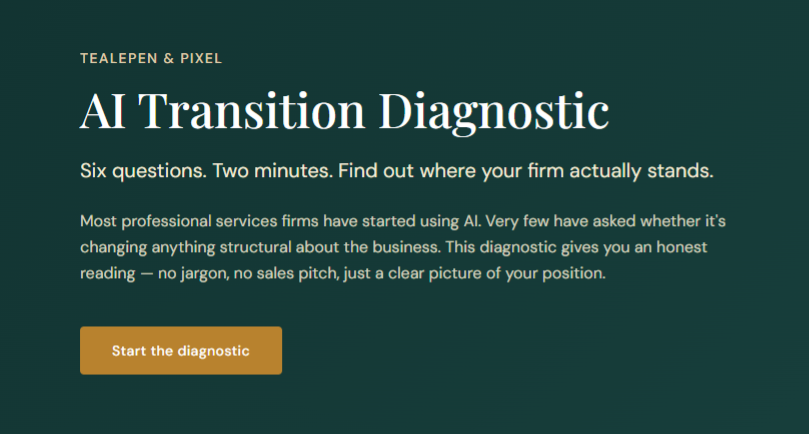
Curious to know where your advice firm sits right now in the profession’s Great AI Transition?
Take our AI Transition Diagnostic – six questions, two minutes. It’ll give you a great starting insight into where your firm currently stands.
Frequently Asked Questions
Do I need any technical skills to start using AI in my advice firm?
No. The most impactful AI adoption for a small IFA firm is strategic: deciding what to automate, in what order, with what compliance guardrails. The technical implementation can be handled by a specialist or by no-code tools like n8n and Make. Your expertise is understanding your firm’s operations. That’s what matters most.
How much should I budget to get started?
Start with what you already have. Most firms on Microsoft 365 E3 or E5 licences are paying for AI capability they’re not using. Beyond that, budget around two hundred to three hundred pounds per month for additional tools — a transcription service, an automation platform, potentially a dedicated LLM subscription. The AI Transition Roadmap I run is a project fee, and gives you the complete picture of where your firm stands and what to prioritise.
What about GDPR and FCA compliance?
The FCA hasn’t prohibited AI use. SM&CR means you’re accountable for outputs regardless of how they’re produced. The key is having a documented governance framework: what AI is used, for what purpose, what human oversight exists and how you ensure suitability. This framework needs to be in place before you deploy any workflow that touches client data. It doesn’t need to be complex. It needs to be clear and auditable.
Can I just use ChatGPT for everything?
ChatGPT is useful for ad-hoc tasks – brainstorming, summarising documents, drafting initial text. But it’s not the deep workflow tool that most advisers need. For systematic AI adoption, you need structured processes where AI is embedded into your operations with proper data flows, compliance checks and human review stages. Typing prompts into ChatGPT one at a time isn’t scalable and it isn’t auditable.
Which AI tools should I be looking at?
That depends entirely on your tech stack, your workflows and your priorities. There’s no universal answer, which is exactly why “best AI tools” listicles are useless for a firm like yours. What matters is whether a tool integrates with your platforms (Intelliflo, Xplan, Microsoft 365), whether it handles data in a GDPR-compliant way, and whether it solves a specific operational problem you’ve already identified. Start with the problem, not the tool.
Is it too late to start if competitors are already using AI?
Not even close. Most firms that claim to be using AI are experimenting with individual tools, not running integrated workflows. The market is still in the early stages. The firms that will win aren’t the ones that started first. They’re the ones that start properly – with a clear assessment, a sensible sequence, and a compliance framework that lets them scale with confidence.
How long before I see a return on investment?
Most firms I work with see measurable time savings within four to six weeks of implementing their first workflow. A typical suitability report automation saves twenty to thirty hours per week for a firm producing twenty-plus reports monthly. The ROI calculation is straightforward: hours saved multiplied by your effective hourly rate, minus the cost of the tools. For most firms, the investment pays for itself within the first month.
What’s the difference between buying AI tools and getting an AI strategy?
Tools solve individual problems. A strategy tells you which problems to solve, in what order, with what resources and what governance. Most firms that “fail” at AI adoption didn’t buy the wrong tools. They bought tools without a sequence, without a compliance framework, and without understanding how the pieces fit together. The strategy is what turns isolated experiments into operational transformation.

Philip Teale is a MCIM marketer with over 10 years’ experience working with financial advisors – helping them gain new revenue and clients using online channels and AI-powered workflows.