
I work closely with AI tools for advice firms. And, even when doing this for a living – working day in, day out – I’m still discovering something new most weeks.
Just last week, a UK adviser messaged me on LinkedIn to put me in touch with a founder building something that genuinely looked impressive: an AI-powered tool wired directly into open finance data. It’s flying almost completely under the radar right now, nobody’s talking about it and there’s no obvious way you’d have found it unless someone happened to tag you in.
AI genuinely has the power to transform a small advice firm. But which tool are you actually meant to use, and how do you evaluate the options without it swallowing your entire week?
The Problem
If you’re a managing partner or director at a small UK IFA firm, you’ve probably had this exact experience: you open LinkedIn and there it is – another AI note-taker, another paraplanning assistant, another “AI-powered” platform claiming to save your team hours a week.
They all use the same language. They all have a free trial. Several of them have already emailed your paraplanner directly. You know you need to move on AI adoption, but you don’t have a reliable way to tell a genuinely good fit from a well-marketed one.
You don’t have time to trial a dozen platforms one by one. You’re not looking for a listicle ranking “best tools.” You’re looking for a way to decide, quickly and with confidence, without needing to become a technologist first.
Why most tool evaluation processes fail before they start
The typical evaluation process in a small advice firm looks something like this: someone sees a tool recommended in a Facebook group or on LinkedIn, books a demo, likes what they see, and asks the team what they think. If the price feels reasonable and nobody objects, it gets adopted.
That process isn’t unreasonable, it’s just missing the two questions that actually matter most:
What specific problem is this solving, and what does saying yes to this tool cost us later, not just now?
There’s also a bigger reason most evaluations go wrong, and it sits underneath the process itself: evaluating a tool in isolation isn’t a strategic decision, it’s a point solution trap.
Judged on its own, almost any well-built tool looks like a sensible yes. The note-taker saves time on write-ups. The paraplanning assistant speeds up first drafts. Each one clears the bar when it’s the only thing on the table.
What rarely gets asked is how this tool fits alongside everything else the firm is already running, or plans to run next.
A firm that evaluates tools one at a time, each in its own bubble, ends up with a collection of individually reasonable decisions that don’t add up to a coherent system.
That’s how most firms end up with three or four overlapping subscriptions, each solving a slightly different sliver of the same underlying problem, none of them talking to each other, and nobody quite sure which one to cancel first.
It isn’t a failure of judgement on any single purchase. It’s what happens when tool selection is treated as a series of shopping decisions instead of one architecture decision, made piece by piece with no one ever stepping back to look at the whole stack.
The four-part evaluation framework
Before an AI tool reaches your firm, it’s worth running it through this framework as a starting point – regardless of who’s recommending it or how good the demo looked.
#1 Capability fit
What specific task is this tool built to do, and is that actually your bottleneck? A tool that summarises meetings brilliantly is useless if your real time drain is suitability report drafting.
Get specific about the job before you look at any tool. Remember, many AI vendors will happily reposition a generic AI wrapper as the solution to whatever problem you mention first!
#2 Compliance and data-handling fit
Where does client data go once it enters this tool, who can access it and how long is it retained? Does the vendor have a clear position on UK GDPR compliance, or a vague one that reads like it was written for a US market?
This isn’t a box-ticking exercise. Under SM&CR, the senior manager remains accountable for how client data is handled regardless of which tool touched it. So this question needs answering before a single client detail goes anywhere near the platform, not after.
#3 Integration fit
Does this tool work with what you already run, or does it ask your team to duplicate work across two systems? If you’re on Intelliflo or Xplan, ask specifically how the tool connects. Is it:
- A direct integration?
- An API connection?
- Or something that needs a workaround through Microsoft 365 or Azure?
A tool with no realistic integration path just becomes another tab your team has to remember to check, which is where adoption quietly dies.
#4 Lock-in and ownership risk
This is the question almost nobody asks, and it’s the one that matters most over a two-to-three-year horizon. If you stopped paying tomorrow, what would you lose?
Some tools are simple utilities you can swap out freely. Others quietly become the place your firm’s institutional knowledge lives.
When you don’t truly own your templates, prompt libraries and workflow logic, it makes switching later expensive and disruptive.
Anf there’s another elephant in the room. As token costs and provider pricing continue to shift, subscription costs on tools like this can rise. If that happens, guess who the costs get passed down to?
The firms building real long-term advantage are the ones asking whether each tool adds to something they own:
- An internal knowledge base
- Adocumented workflow
- Agenuine intelligence layer
Not just adding another rental to the pile.
Run every serious candidate through these four questions in this order. Most tools fail at question one or two before you ever need to worry about the rest, which saves you the time of trialling something that was never going to fit.
The false belief this exposes
This is the false belief that quietly drives most tool decisions: The best tool is the one that’s most well-known – with the most features, the best reviews or the lowest price.
It feels like a safe, rational way to choose, because it’s the same logic you’d use to buy most software. But AI tools for an advice firm aren’t like most traditional software.
The cost of a bad fit isn’t just wasted subscription money. It’s duplicated admin, a compliance gap nobody flagged or a firm that’s three tools deep into a stack that doesn’t talk to itself.
The tools with the flashiest feature lists are very often the ones optimised for demos, not for the narrow, specific job your firm actually needs done.
Meanwhile the genuinely well-fitted tool, the one that integrates cleanly with your back office and keeps your data exactly where your compliance framework says it should be, may not have the most exciting marketing.
Evaluating on features and price is optimising for the wrong variable. Evaluating on fit, compliance and long-term ownership is what actually protects the firm you’ve built.
Where to go from here
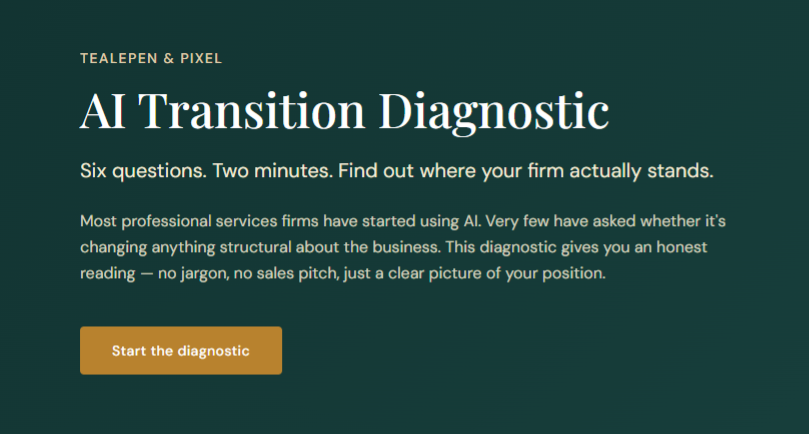
Curious to know where your advice firm sits right now in the profession’s Great AI Transition?
Take our AI Transition Diagnostic – six questions, two minutes. It’ll give you a great starting insight into where your firm currently stands.
Frequently asked questions
Should I trial a tool before committing, or is that a waste of time?
Trials are useful, but only once a tool has already passed crucial checks – e.g. compliance and integration. Trialling first and asking those questions afterwards is how firms end up emotionally attached to a tool before finding out it can’t actually connect to their back office.
What’s the biggest red flag when evaluating a vendor?
Vagueness about data handling. If a vendor can’t clearly explain where client data is stored, who can access it, and how long it’s retained, that’s not a detail to chase up later. It’s a reason to stop the evaluation there.
Is it worth paying more for a tool built specifically for financial advice, versus a generic AI platform?
Often yes, because a sector-specific tool is more likely to already understand UK compliance requirements and back-office integrations, which saves you having to build those safeguards yourself. But “built for advisers” isn’t a guarantee, and it still needs to be run through the same four checks rather than taken on trust.

Philip Teale is a MCIM marketer with over 10 years’ experience working with financial advisors – helping them gain new revenue and clients using online channels and AI-powered workflows.