
Could AI just save you a bit of time, or could it completely change the economics of a UK financial advice firm? I recently completed an AI Transition Roadmap with a London-based adviser, and I can confidently tell you it’s the latter.
AI advisertech is often marketing along these lines: “Make your existing processess faster.” That sounds good, until you ask yourself the deeper question: “Should we even still be doing things as we have done over the last 20 years?”
Without that deeper, more strategic question answered, financial advisers risk falling into a common trap:
Advisers often assume that producing more work, faster, means becoming less busy. In practice it rarely does: the time AI frees up usually gets reabsorbed into more activity, not more deep work.
The firms that are winning with AI recognise this Productivity Trap and aren’t simply settling for another point solution bought off the shelf.
They’re using the capacity AI creates to redesign what they offer, who they serve and how they get paid for it.
Who this is for
If you’re a managing partner, director or technical/operations person at a UK IFA firm, you’ve probably already tried a few AI solutions. An AI note-taker. Maybe automated a first draft of a suitability report. Th ere may have been a small relief of getting an hour back here and there.
That’s a real result, and it matters. But if that’s where your thinking about AI stops, you’re treating a strategic shift as a collection of efficiency tools. The danger is, the advisers who don’t make that mistake may pull ahead of you. Not because they’re better advisers, but because they’ve rebuilt what “a client relationship” costs them to deliver.
The productivity trap
Here’s the pattern worth naming plainly, because it catches the great majority of firms.
An adviser assumes that if AI lets them produce more work in less time, they’ll simply become less busy. That’s rarely what happens.
A firm adopts AI note-taking. Meeting prep and write-up drops from 45 minutes to 15. That’s genuinely 30 minutes reclaimed per client meeting.
But what happens to that 30 minutes? In the vast majority of firms, nothing structural. It gets filled almost immediately with more activity:
- More meetings
- More admin that quietly expands to meet the time available
- More of the same kind of work at a slightly higher volume.
What it doesn’t get filled with, unless someone decides deliberately, is deep work: the strategic thinking, planning and judgement that actually moves a practice forward.
That’s the productivity trap. You’re producing more, moving faster, and somehow no less busy, because speed was never the constraint that mattered.
The business model underneath, same service tiers, same pricing logic, same one-adviser-to-X-clients ratio, hasn’t changed. You’ve just executed it with slightly less friction.
The point solution trap
This is also my reservation about most off-the-shelf adviser technology. A point solution, an AI note-taker, a document summariser, a chatbot bolted onto a website, genuinely does solve a specific time-saving problem for a specific workflow.
What it never does, because it isn’t designed to, is ask whether that workflow should exist at all, or what your practice should look like in twelve months.
A point solution optimises the step directly in front of it. It has no opinion on whether the steps either side of it are worth keeping, whether they could be removed entirely, or whether the whole process they sit inside should be rebuilt around what AI now makes possible.
Bought one at a time, in response to whichever admin pain is loudest that month, they add up to a stack of isolated fixes rather than a coherent practice. Each tool, in isolation, looks like a sensible purchase. The collection of them rarely adds up to a strategy.
Three ways advisers are responding to AI right now
Broadly, I see three responses from advisers to all of this:
1. Denial
treating AI as background noise, assuming it isn’t materially changing the market or how advice gets delivered and carrying on exactly as before. That’s an increasingly risky position to hold, but it’s at least a coherent one.
2. Diving in headfirst, without thinking about the treadmill they’re stepping onto
These are the advisers who’ve picked up ten or twelve different AI point solutions, one for notes, one for drafting, one for marketing content, one for data entry, each chosen to solve a specific problem in isolation.
The irony is that the time saved on each individual task often ends up spent managing the tools themselves: reconciling outputs between systems that don’t talk to each other, checking which tool did what, trying to get a dozen disconnected products to behave like one practice.
The treadmill doesn’t disappear here. It just gets a new kind of admin riding on top of it.
3. Being deliberate and strategic
These advisers start from first principles rather than from a tool catalogue. The question isn’t “what can I buy to save time on this task,” it’s “which work should exist in this practice at all, and which category does it fall into.” Broadly, work splits into two kinds:
- The human premium work. The judgement calls, the trust-building, the complex planning conversations, where a human genuinely needs to be present and where the firm’s value is actually created
- The friction. The steps that exist mainly because nobody’s redesigned the process around what’s now possible, and that systems could handle with proper oversight. Getting that split right, deliberately and firm-wide rather than solution by solution, is what separates a practice that’s transforming from one that’s just accumulating software.
What changes when UK advisers get this right
Get that split right, and something structural starts to shift:
The relationship between staff headcount and client headcount decouples.
Traditionally, growing a book means growing the team to match it, another paraplanner, another adviser, another pair of hands on admin, because the work has always scaled roughly linearly with clients.
If your systems are genuinely handling the friction work, taking on ten more clients doesn’t automatically mean a new practice manager, consultant or paraplanner. The work that used to scale with headcount increasingly doesn’t.
That has real implications, not abstract ones.
It changes the revenue and profit margin maths of growth, because client numbers can increase without a proportional cost base behind them.
It changes the client experience, because the adviser’s time is increasingly spent on the human premium work clients actually value, rather than administration they never see the benefit of.
It can also reopen pricing conversations that have quietly drifted over the years from reflecting what a relationship actually costs to service well, to reflecting what’s always been charged.
And it changes the hiring trajectory of the firm: when new people do come on, they’re high-value hires suited to the kind of practice that’s emerging, rather than headcount added simply to keep pace with growth.
This is most visible, and most powerful, in a firm starting from a genuinely blank slate.
A new practice that designs itself around this distinction from day one, rather than retrofitting it onto twenty years of existing process, is building what’s increasingly being called an AI-native practice, one where the ratio of clients to staff was never assumed to be fixed in the first place.
What this looks like in practice
I recently worked with a small UK advice firm on exactly this, an AI Transition Roadmap engagement, run across three sessions looking at the practice as a whole:
- The client journey end to end
- Every workflow and handoff involved in it
- The tools already in use
- Where AI could realistically be applied across all of it.
What came out the other side wasn’t a list of tools to buy. It was a structured plan for the next six months to build the systems needed so the firm can take on more clients without adding headcount at the same rate it would have previously.
When new people do join, they’re brought in as high-value hires suited to this emerging way of working, not just extra capacity to cover admin. That’s the practical shape of decoupling headcount from client count: not a theory, a six-month build plan.
The false belief this exposes
The belief keeping most firms on the treadmill is simple: AI is just about making my existing processes faster.
It feels true, because the first honest use case for most advisers is exactly that, and because the point solutions on the market are built to reinforce it, one tool, one task, one small time saving at a time.
But mistaking a faster process for a different business model is exactly why so many firms will spend the next few years producing more, buying more tools, and still not getting anywhere different.
The market right now is almost entirely stuck at this stage.
Most of what’s discussed on LinkedIn and at industry events is tool comparisons and prompt tips, which is useful but incremental, point solution thinking dressed up as strategy.
Almost nobody in this space is talking about what a financial advice business model looks like once the old link between headcount and client numbers starts to break.
That’s not a criticism of advisers, it’s a genuine gap. And it’s the reason firms who move past the point solution stage now have a real structural head start, not just a marginal one.
Where to start, practically
You don’t need to redesign your entire business model this quarter. You need two habits.
First, before adopting any new AI tool, ask the point solution question explicitly: not just “does this save time,” but “should this workflow exist in its current form at all, and does this tool get us closer to the practice we want in twelve months, or just further down the one we’re already on.”
Second, the next time AI saves your team meaningful time, ask what you’re deliberately going to do with it, in a partners’ meeting, on the record, rather than letting it quietly disappear into more of the same activity.
Those two questions, asked consistently, are the difference between a firm that’s slightly more efficient in five years and a firm whose business model, and whose relationship between headcount and clients, looks genuinely different.
Where to go from here
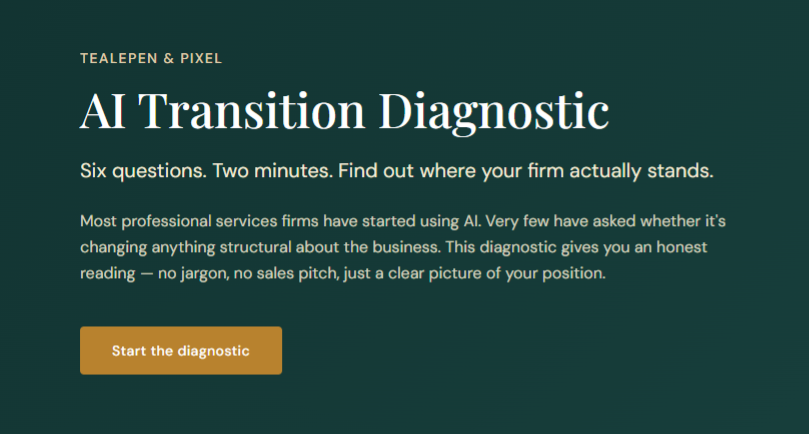
Curious to know where your advice firm sits right now in the profession’s Great AI Transition?
Take our AI Transition Diagnostic – six questions, two minutes.
It’ll give you a great starting insight into where your firm currently stands.
Frequently asked questions
Isn’t faster admin still a good thing, even if it’s not transformational?
Yes, entirely. Nobody should turn down thirty minutes back per meeting. The point isn’t that efficiency gains are bad, it’s that stopping there means you’ve captured a fraction of what’s actually available, and that the time saved often just gets reabsorbed into more activity rather than deep work. Treat the time saved as a decision to be made, not a bonus to be absorbed.
What’s the difference between the productivity trap and the point solution trap?
The productivity trap is what happens to the time you save: it quietly fills with more activity instead of being deliberately redirected. The point solution trap is what causes it: buying tools one at a time to fix whichever admin pain is loudest, without ever asking whether the underlying workflow should exist, or what the practice should look like in a year. They reinforce each other. A string of point solutions produces a string of small productivity traps.
Is buying more AI tools better than buying none at all?
Not automatically. Advisers who dive in headfirst, picking up ten or twelve point solutions for ten or twelve separate problems, often end up spending the time they saved on each one managing the tools themselves: reconciling outputs, checking which system did what, trying to get disconnected products to behave like one practice. More tools without a first-principles view of the practice can mean more admin, not less.
How do I know if my firm is stuck on the treadmill?
A useful test: has any AI adoption in your firm changed a pricing structure, a service tier, or what your firm offers, or has it only changed how quickly existing work gets done? If it’s only the second, you’re on the treadmill, which is a completely normal place to be. The opportunity is in noticing it.

Philip Teale is a MCIM marketer with over 10 years’ experience working with financial advisors – helping them gain new revenue and clients using online channels and AI-powered workflows.